

By Muhammad Azam, Founder of Rohaan Oil Store · Last updated: 28 November 2026 · Hair Care Journal
Short answer: A split end is a tip that has frayed into 2 or more pieces. Curly and black hair splits first. Scalp oil takes days to work down a curl. The last 5 cm stay dry, and dry ends crack at the bends. Cut the split off. Coat the new end with oil so the next one does not form.
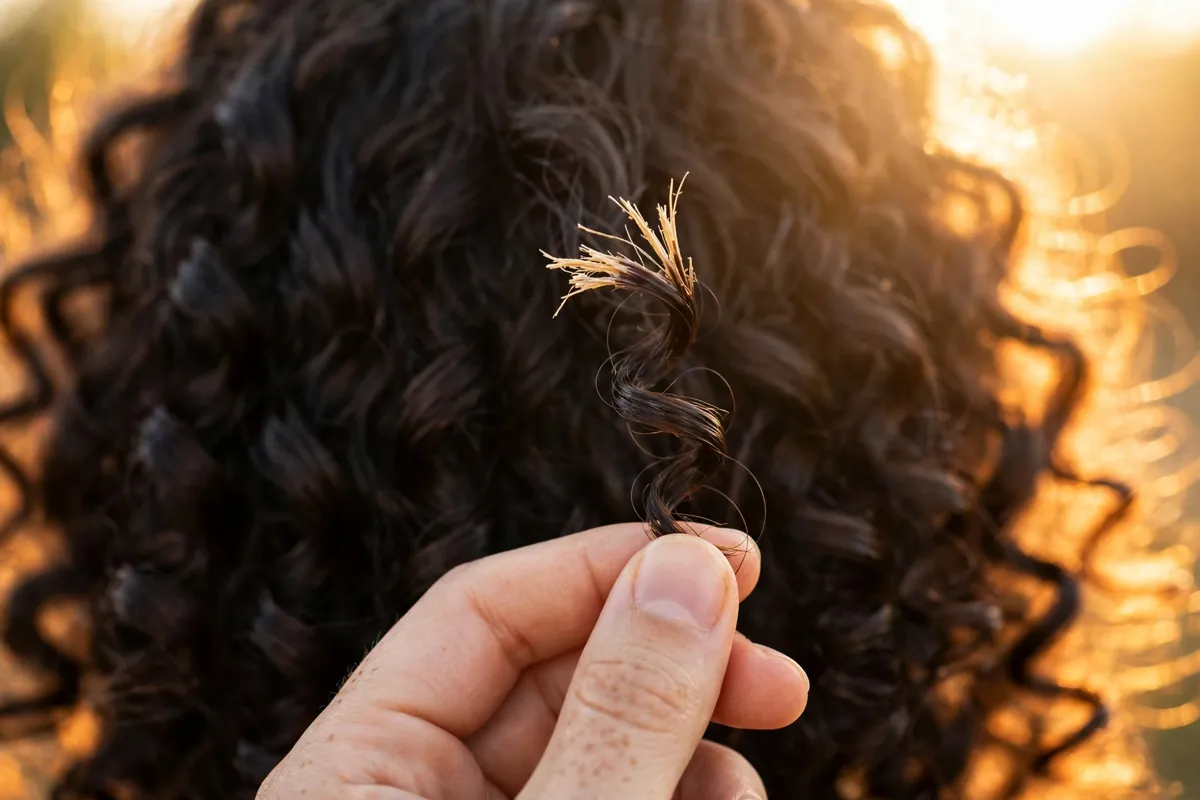
Hold one curl up to a window. Look at the last centimetre. Pale colour, a straw feel between your fingers, a tip that will not clump — that is not dryness you can wash out. That is a split.
Here is the part nobody selling a serum wants printed: a split does not close. Oil will not close it. A mask will not close it. A Rs. 3,000 treatment will not close it either. The strand is dead keratin, and dead keratin does not heal. Cut the split off. Then change the 4 or 5 habits that made it. Skip that second part and you will cut again in 10 weeks.
The split ends curly hair produces follow a pattern. This post names the 6 shapes a split takes. It gives you a 60-second test that finds splits hidden inside a curl. It ends with the routine that stops new splits forming.
What a split end actually is
A strand of hair has 3 layers. The outside layer, the cuticle, works like roof tiles: flat, overlapping, pointing down. Under it sits the cortex, the fibre that gives hair its strength.
Shoulder-length hair is 2 to 3 years old at the tip. That tip has survived roughly 300 washes, 1,000 comb-throughs, and every ponytail you have worn since 2023. The cuticle tiles at the tip wear thin, lift, and break away. Without the tiles, the cortex fibres separate lengthwise. That separation is the split. The medical name is trichoptilosis.
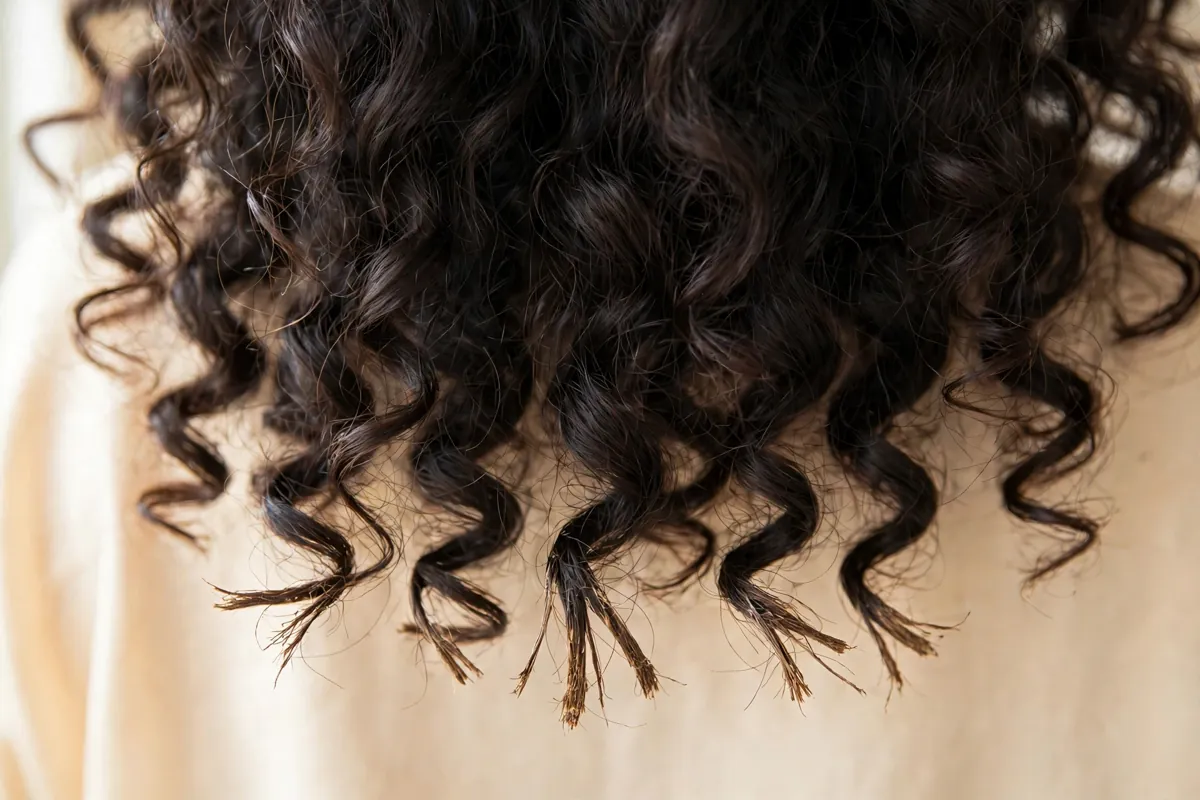
Once the fibres separate, the split runs upward. A 2 mm split in January is a 15 mm split by April if the strand keeps rubbing against cotton, collars and other strands.
Why curls and black hair split before straight hair does
The split ends curly hair develops are not bad luck. Three reasons cause them, and all three are geometry.
The oil does not arrive. Your scalp produces sebum every day. On straight hair, sebum slides down the shaft in hours. On a curl, sebum has to travel around every turn of the spiral. The last 5 cm of a tight curl gets close to zero sebum. Dry fibre cracks; oiled fibre bends.
Every bend is a weak point. A straight strand has no bends. A curly strand has a bend every 1 to 3 cm, and the outside of each bend is stretched thinner than the inside. Splits start on the outside of bends.
Coily hair is thinner at the twist. Black hair grows from an oval follicle, not a round one. The strand is flat at the twist points. Flat sections snap under tension that a round section survives. So the split ends black hair grows hide better and break sooner. The split sits inside the coil. You see nothing — until the end comes off in your hand.
Split ends curly hair makes: the 6 shapes
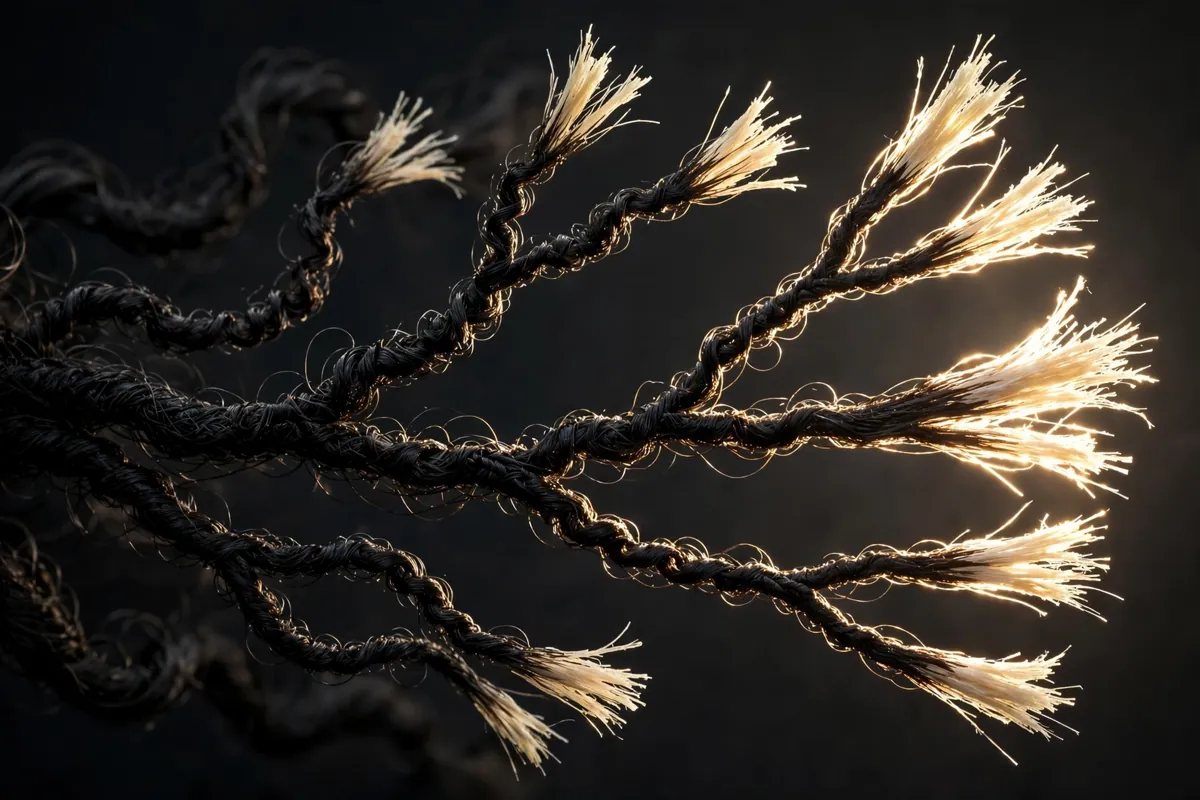
Not every split needs the same amount cut off. Find yours in this table before you book a trim or pick up scissors.
| Shape | What you see | How far the damage has run | What to cut |
|---|---|---|---|
| Baby split | Tip divides into 2 for 1–2 mm | Surface only | 3 mm |
| Classic Y | Tip divides into 2 equal arms, 3–8 mm long | Cuticle gone at the tip | 1 cm above the fork |
| Double Y | One arm of the Y splits again | Damage is 2 layers deep | 1 cm above the highest fork |
| Tree | Tip divides into 3–5 branches | Cortex is exposed and fraying | 1.5 cm above the lowest branch |
| Feather | Short splits repeat down one side like a feather | Repeated friction on one side — a bag strap, a collar, a sleep side | 2 cm, plus fix the friction source |
| White dot | A white or pale dot sits 1–3 mm from the tip, strand bends at the dot | Heat damage. The strand will snap at the dot within weeks | Cut 2 mm above the dot |
A white dot is not a split yet. It is worse news than a baby split, because the break point is already set.
The 60-second twist test
Splits hide inside curls. This test pulls them out into the open. Do it in daylight, at a window, on dry hair.
- Take a section of hair 2 cm wide from the back of your head — the back takes the worst pillow friction.
- Twist the section firmly from root to tip, the way you would wring a cloth.
- Look at the short hairs that poke out of the twist. Healthy poked-out hairs have clean, pointed tips. Split ones end in a fork, a branch, or a white dot.
- Count. 0 to 3 splits in the section: your routine is working, trim in 8 weeks. 4 to 10 splits: dust the ends this week (see Step 1). More than 10, or any tree or feather shapes: book a trim, dusting will not catch up.
Write the count down. Repeat the test on the same section in 8 weeks. If the number fell, the routine in this post is working on your hair, not on hair in a study.
5 steps that stop split ends
Step 1: Cut what is already split — dusting counts
You do not need a full haircut. Dusting removes 3 to 6 mm — ⅛ to ¼ inch — from the tips only. Length, shape and layers stay untouched.
Two rules for dusting at home. Use hair scissors, never kitchen or paper scissors: a dull blade crushes the fibre and creates a new split in 2 to 3 weeks. And cut dry, stretched curls, not wet ones. Wet hair stretches up to 30% beyond its dry length, so a wet cut removes more than you measured once the hair dries.
Salon trim instead of dusting if you found tree splits, feather splits, or white dots in the twist test. Those need 1.5 to 2 cm off, and guessing that length at home ends in uneven ends.
Step 2: Cap your heat at 185°C
Flat irons ship set between 200°C and 230°C. Keratin starts breaking down at 180°C.
- Fine or chemically treated hair: 150°C (300°F), 1 pass per section
- Thick, coarse hair: 180°C (355°F) maximum, 1 pass per section
- 2 heat-free days per week, minimum
- Heat protectant on every section, every time — not on the days you remember
If your iron has no temperature display, it has one setting, and that setting is too hot for ends. Use it on roots only.
Step 3: Put oil on the last 5 cm, in drops, not palms
Oil does 2 jobs on an end. It fills the gaps between lifted cuticle tiles, so the strand slides instead of snagging. It also slows water leaving the fibre after a wash.

Measure it. Use 2 drops for hair to the shoulders. Hair past the shoulder blades needs 3 drops. Rub the drops between your palms. Press them onto the last 5 cm only. Oil on the scalp does nothing for a split 20 cm away. The split ends curly hair forms sit at the tip, so the tip gets the oil.
Timing matters more than the brand of oil. Put the 2 drops on damp hair in the 5 minutes after a wash, while the fibre is full of water. That is the water you are sealing in. Oil on bone-dry hair at night coats the outside and seals nothing.
Coconut oil, almond oil and argan oil all do this job. Pick by feel: coconut oil leaves fine hair stiff in cold weather, almond oil does not. The oils named here are in our Shop if you need one; the routine works with a bottle you already own.
Step 4: Oil 30 minutes before the wash, twice a week
Shampoo strips oil from the tip first, because the tip has the thinnest cuticle. Coat the length and ends with oil 30 minutes before you wash, or the night before a morning wash. The shampoo then removes the applied oil instead of the fibre’s own lipids.
Wash in lukewarm water — 37°C, the temperature of a warm shower you can stand under without flinching. Hot water lifts cuticle tiles. Lifted tiles are next month’s splits.
Step 5: Remove the 4 friction sources in your house
Splits are a friction bill coming due. These 4 sources charge you every day:
- A cotton pillowcase. Cotton grabs a curl and holds it while your head moves. Switch to satin or silk, or tie hair in a loose satin scarf. Cost of the switch: one pillowcase. Saving: 7 to 8 hours of rubbing per night, gone.
- A rough towel rub. Rubbing a towel over wet curls is sandpaper work on stretched, weak fibre. Press the towel against the hair and squeeze. 30 seconds, no rubbing.
- A tight elastic in the same spot daily. The strand breaks at the elastic line. Move the ponytail position every day, and use a fabric-covered band with no metal join.
- Brushing dry curls. A brush on dry curly hair drags tangles down into the ends. The ends snap there. Detangle wet instead, with conditioner in. Use your fingers first, then a wide-tooth comb. Start 5 cm from the tip and move up 5 cm at a time. Healthline’s guide to preventing split ends and breakage gives the same wide-tooth comb advice. The American Academy of Dermatology also lists towel-rubbing and dry brushing as habits that damage hair.
A week that works: the routine on one page
Print this table. Stick it inside a bathroom cabinet door. It is the whole answer to the split ends curly hair problem, on one page.
| Day | Action | Time it takes |
|---|---|---|
| Monday | Wash day. Oil ends 30 min before washing. 2 drops on damp ends after. | 35 min total |
| Tuesday | Nothing. Hair up in a loose, high ponytail for sleep. | 0 min |
| Wednesday | 1 drop pressed onto dry ends if the tips feel like straw at 6 pm. Twist test if it is week 8. | 1 min |
| Thursday | Wash day, same as Monday. Detangle wet, fingers first. | 35 min total |
| Friday | Nothing. Ponytail in a different position from Tuesday. | 0 min |
| Saturday | Heat styling day if you want one: protectant, 180°C cap, 1 pass. | Your call |
| Sunday | Oil the length the night before Monday’s wash if your ends felt dry twice this week. | 2 min |
| Every 8–12 weeks | Dusting (3–6 mm) or a trim (1–2 cm if the twist test found trees, feathers or white dots). | 20 min |
Total added work: under 15 minutes a week, outside wash days you already have.
More routines and problem guides sit in our Hair Care Library.
5 habits that put splits back after you cut them off
- Buying a product that promises to repair a split. The forked fibres get coated and lie flat until the next wash. The fork is still there at 9 pm under the coating. Cut first, coat second — never the other way round.
- Skipping trims for 12 months to gain length. Hair grows 1 to 1.25 cm a month from the root. A split end breaks off 1 to 2 cm in the same period. Twelve months of no trims is 12 to 15 cm grown and up to 12 cm broken. That trade is how hair stays at one length for years. (Our next post, Do Split Ends Stop Hair Growth?, does this maths in full.)
- Straightening split ends flat to hide them. You are pressing a 200°C plate onto the weakest 2 cm of the strand. The split runs upward within 2 weeks.
- Washing the ends with shampoo on every wash. Shampoo belongs on the scalp. The foam that rinses down the length cleans the ends without a second scrub.
- Cutting with the scissors from the kitchen drawer. Step 1 covered this, and it undoes Step 1. A crushed cut re-splits in 2 to 3 weeks. You pay for the same trim twice.
Myths vs facts
| Myth | Fact |
|---|---|
| Oil repairs split ends | Oil coats a split and slows the next one. A split is removed by cutting, and by nothing else |
| Split ends stop hair growing | Hair grows 1–1.25 cm a month at the root. Splits break 1–2 cm off the tip. Growth continues; length does not |
| Trimming makes hair grow faster | A trim changes the growth rate by 0 cm a month. It changes the breakage rate, which is the number that was eating your length |
| Straight hair does not split | Straight hair splits from heat and colour. Curly hair splits sooner because sebum reaches straight ends in hours and curly ends in days |
Frequently asked questions
Can a split end be repaired without cutting?
No. A coating product holds the 2 arms of a split together until the next wash — 2 to 4 days of appearance, 0 repair. Cutting 3 mm to 2 cm, depending on the shape in the table above, is the complete list of fixes.
How do I find split ends in black hair if I cannot see them?
Run the twist test in this post at a window. Splits in coily hair sit inside the coil and do not show on a straight look. Twisting a 2 cm section forces the damaged tips out of the coil, where the forks and white dots become visible against daylight.
How much should a trim take off?
Dusting takes 3 to 6 mm and suits baby splits and classic Y splits. Tree splits, feather splits and white dots need 1.5 to 2 cm. Cutting 1 cm above the highest visible fork is the rule when you are unsure which shape you have.
Which oil should I use on the ends?
Coconut, almond and argan oil all coat the fibre and cut friction between strands. For the split ends curly hair forms at the tip, the oil choice matters less than the dose. Use 2 drops on shoulder-length hair. Hair past the shoulder blades needs 3 drops. Apply on damp hair, within 5 minutes of washing. Coconut oil stiffens fine hair in cold weather. Switch to almond oil in winter if your ends feel hard instead of soft.
Why do my ends split again 1 month after a trim?
One of 4 causes did it, in this order of likelihood. First: the trim took less than the damage — a 5 mm dusting under a 15 mm tree split. Second: the scissors were dull. Third: heat stayed above 185°C. Fourth: the pillowcase is still cotton. Run the twist test and check the shape. The shape tells you which cause to fix. This is the pattern behind the split ends curly hair keeps bringing back after a haircut.
Do split ends make hair look thinner?
Yes, and the maths is plain. Breakage hits strands at different heights, so the bottom 5 cm holds fewer full-length strands than the section above it. Fewer strands in the last 5 cm reads as thin, see-through ends, while the hair at the root stays thick.
Key takeaways
- A split is a cuticle failure at a tip that is 2 to 3 years old. It does not heal and it runs upward at roughly 13 mm over a season if friction stays unchanged.
- The split ends curly hair grows split first for 3 geometric reasons. Sebum arrives days late. Every bend thins the strand. Coily hair is flat at the twist.
- Name your split shape before you cut. Baby split: 3 mm. Tree split: 1.5 cm. White dot: cut above the dot.
- The fix is 5 habits, not 5 products. Dust on time. Cap heat at 185°C. Put 2 drops of oil on damp ends. Oil 30 minutes before a wash. Remove cotton, towel-rubbing, fixed elastics and dry brushing.
- Test, do not guess. Twist test today, count the splits, test again in 8 weeks.
Cut the split. Change the habit that made it. That is the whole treatment for the split ends curly hair produces — cut, change, recount. Count again in 8 weeks and let the number tell you whether it worked.
Next in this series: “Do Split Ends Stop Hair Growth?” — Blog #2 in the Rohaan Oil Store SEO Blueprint.
— Rohaan Oil Store, Hair Care Journal
About the author: Muhammad Azam is the founder of Rohaan Oil Store, Mughalpura, Lahore. He makes the store’s Gold Hair Oil and Follicle Activator, and writes the Hair Care Journal from what buyers ask him every week.

